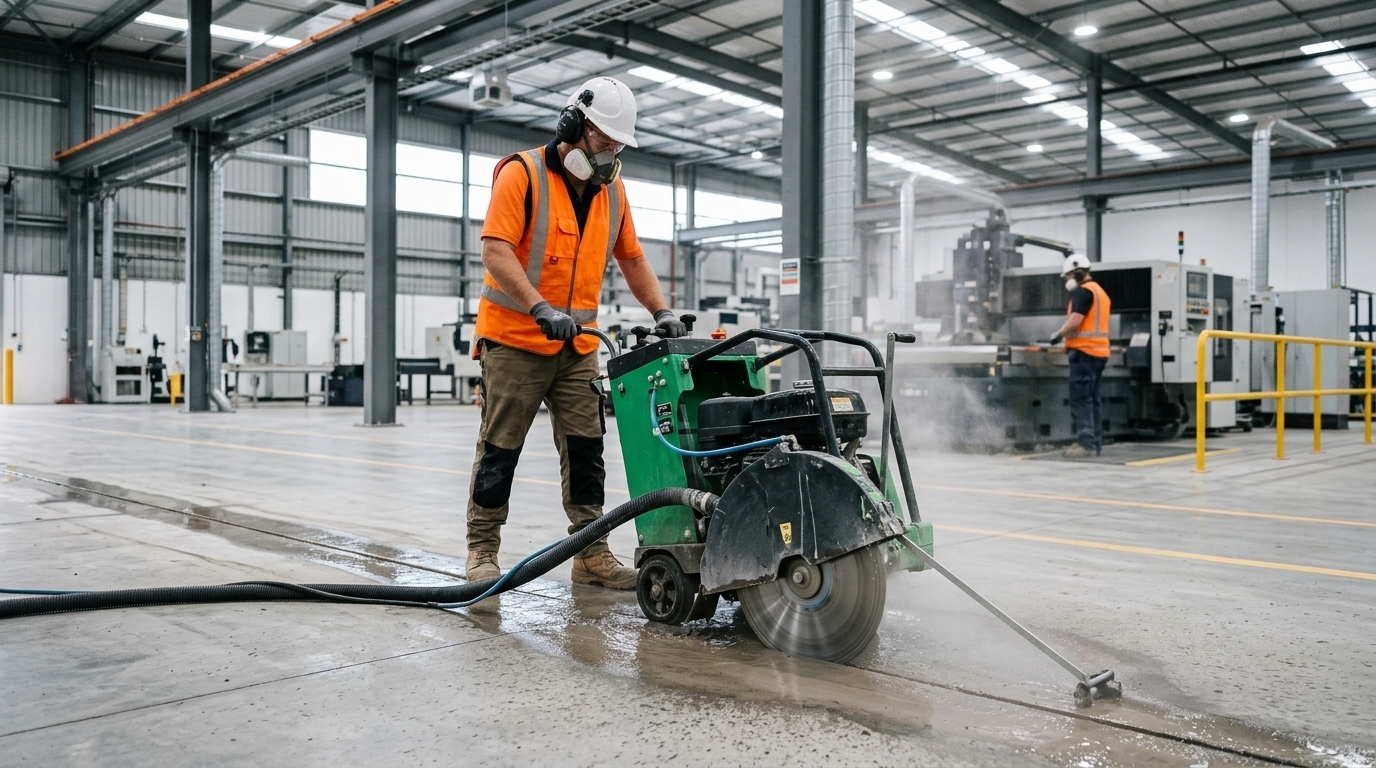
Grand Rapids Concrete Cutting, Sawing & Core Drilling
Slab sawing, wall sawing, wire sawing and core drilling for West Michigan manufacturing floors, medical campuses and downtown renovations.
Specialty: Manufacturing Floor Trenching, Medical Campus Renovations and Heavy Equipment Pad Removal
Concrete Cutting Contractors in Grand Rapids: Quick Answer
Concrete cutting contractors in Grand Rapids, Michigan open walls, saw slabs, core penetrations and scan reinforced concrete for manufacturing floor trenching, medical campus renovations and heavy equipment pad removal. Success depends on what is inside and around the concrete (glacial outwash soils, grand river floodplain groundwater, and deep-frost freeze-thaw slab movement), scanning for rebar, tendons and utilities before any cut, and slurry, dust and noise control that fits an occupied building. Typical capabilities in this market are listed below and are confirmed project by project with the engineer of record.
The Concrete Cutting Guide for Grand Rapids Owners, GCs and Facility Managers
Grand Rapids is a city that was built to make things. It earned the name Furniture City in the nineteenth century, and furniture, office-systems, automotive-supply, metal-stamping and food-distribution plants still fill its industrial districts. The metro area holds roughly 1.2 million people, by recent estimates, and the regional economy leans on manufacturing and healthcare in about equal measure. For anyone who owns or runs a building here, that mix produces a steady, quiet demand for concrete cutting: a new floor drain through a plant slab, a doorway where a wall used to be, a chase for conduit under a cleanroom, a machine foundation that has to leave before the next line arrives.
Two clusters of work set the rhythm. The first is healthcare and research along Michigan Street, the area locally called the Medical Mile, where Corewell Health, Van Andel Institute, Grand Valley State University and Michigan State University's College of Human Medicine sit within walking distance of each other. Corewell Health has publicly described a large new hospital tower on its Butterworth campus, with a completion target around 2030, and every year of that program means demolition, utility relocation and renovation of the buildings around it. The second cluster is industrial and sits in the suburbs that wrap the city: Walker and its Alpine Avenue plants to the northwest, the 28th Street corridor through Wyoming and Kentwood, and the industrial parks southeast of downtown. Retooling in those plants is rarely glamorous, but it is constant.
That is why a specialty cutting contractor matters more than a general contractor with a rental saw. Plant floors in West Michigan are often thick, heavily reinforced and sometimes post-tensioned or embedded with radiant tubing, electrical duct banks and old process piping that nobody drew accurately. A cut that looks simple on a plan can hit a conduit bundle, strand a rebar mat or release a slab edge that was carrying more load than expected. Scanning before cutting, choosing between a flat saw, a wall saw, a core rig or a wire saw, and managing slurry in a building that is still producing food or medicine are skills that live with the specialist, not with the trade partner who happens to hold the permit.
This guide is written for owners, facility managers and general contractors planning cutting work in Grand Rapids and its neighboring cities. It covers the ground and groundwater the work sits on, who permits it (the answer changes when you cross from Grand Rapids into Wyoming, Kentwood or Walker), what actually moves the price and the schedule, how Lake Michigan weather shapes the calendar, and the four corridors where most projects originate. Treat it as orientation, not engineering advice: every cut should be confirmed by the engineer of record and by the permit office that has jurisdiction over the address.
Grand Rapids Concrete Cutting Services
Four core scopes, each with its own local considerations.
Flat Sawing & Utility Trench Cutting
Slab cuts for floor drains, process piping and conduit runs inside active manufacturing and food-processing plants.
Wall & Door Opening Sawing
Controlled wall sawing for new doorways, loading openings and renovation access in occupied buildings.
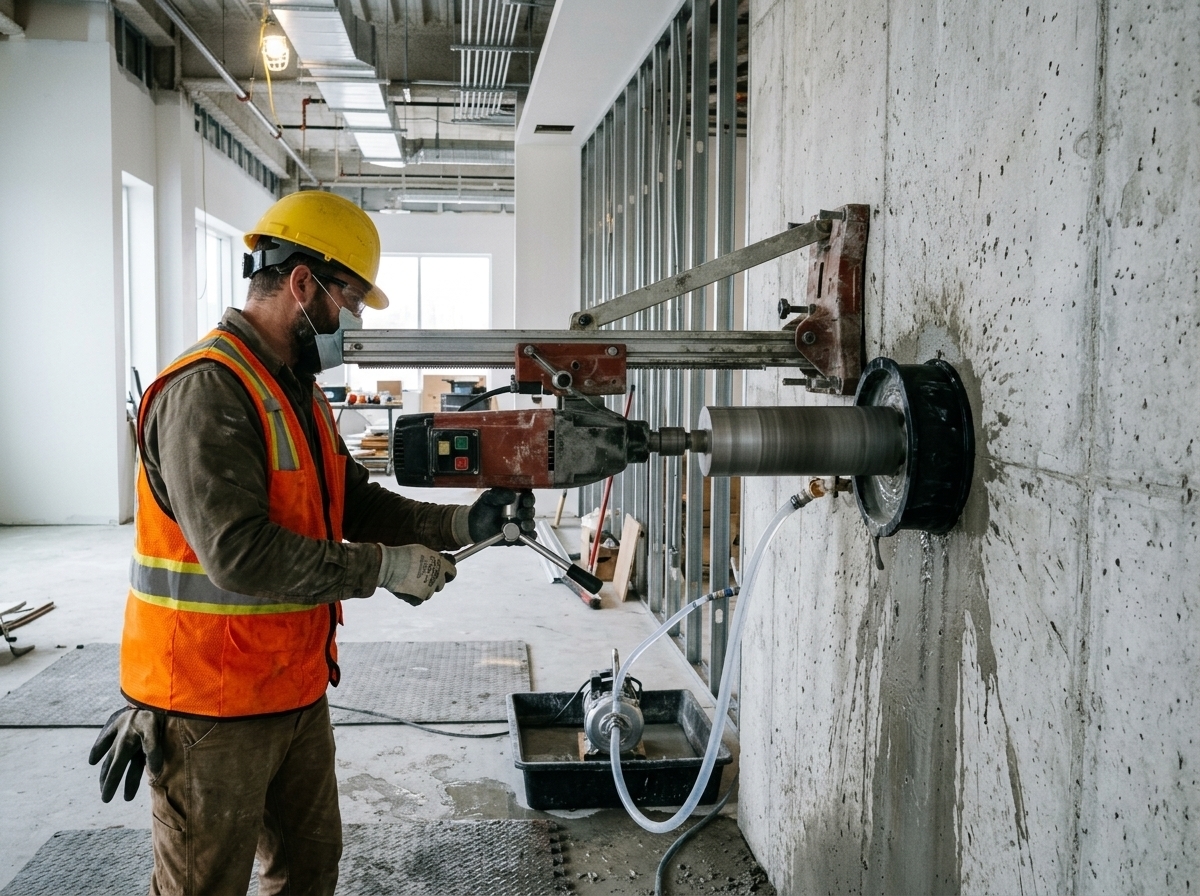
Precision Core Drilling
Wet and dry core drilling for pipe, duct, conduit and anchor penetrations through floors, walls and decks.
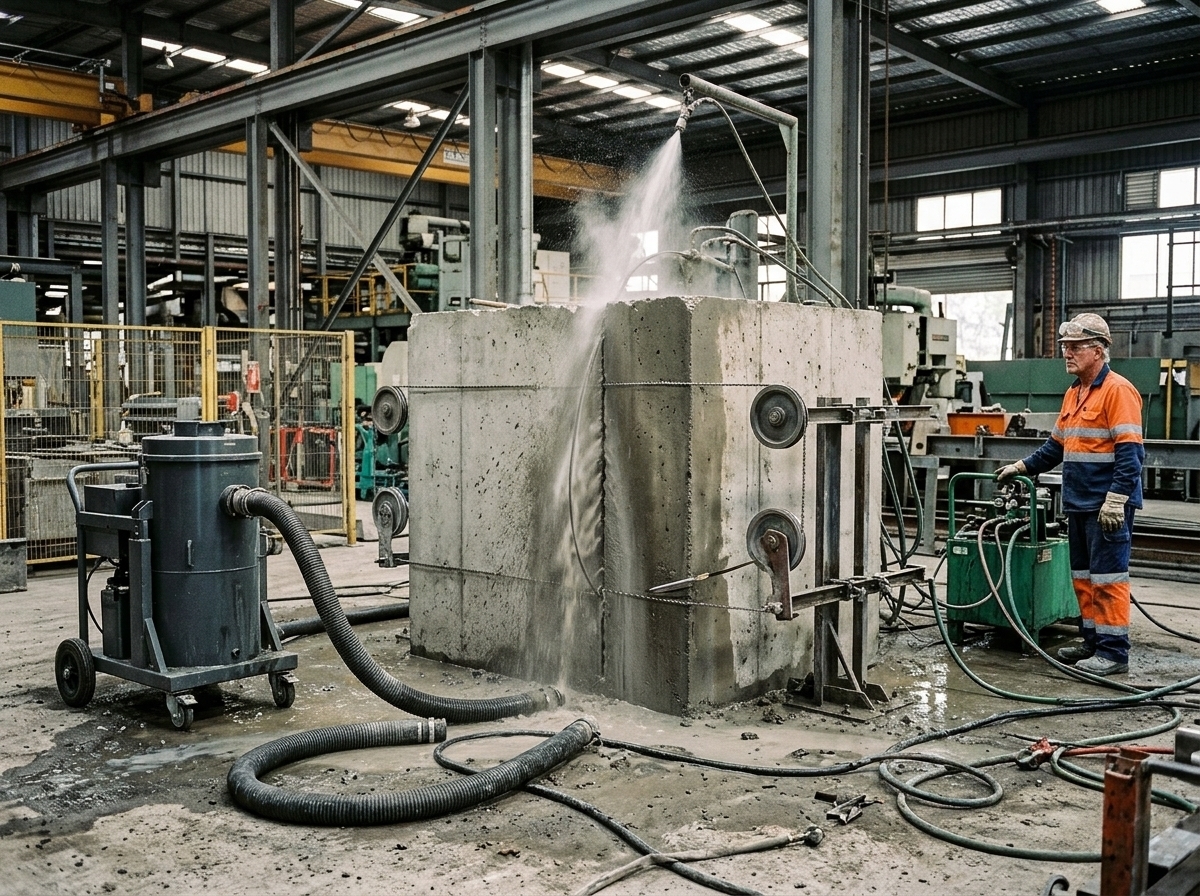
Wire Sawing & Heavy Concrete Removal
Wire saws that section thick pads, machine foundations and structural members for removal.
Concrete Cutting Scopes We Handle in Grand Rapids
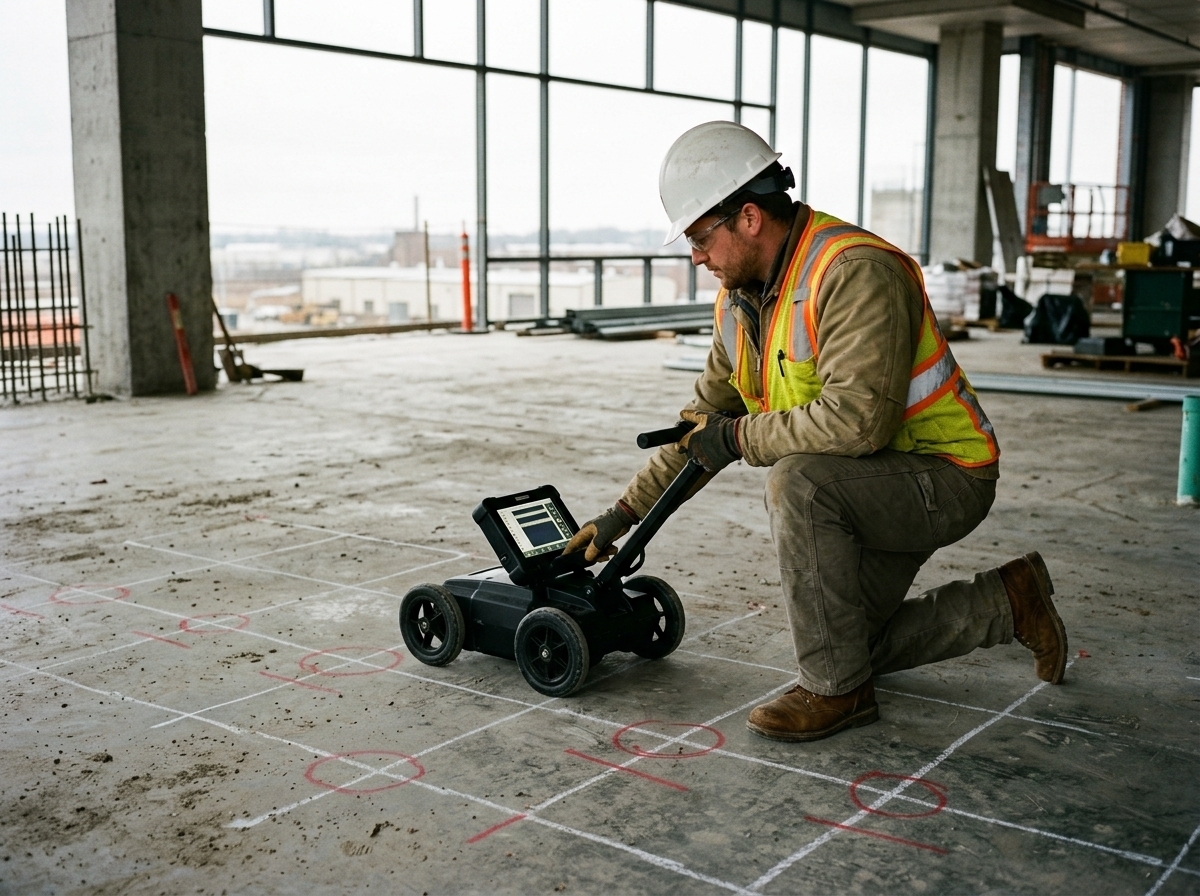
Illustrative renderings of the scope types, not photographs of completed projects.
Industrial Corridors We Serve
The path from bid to cleanup
Concrete Cutting Project Timeline in Grand Rapids
- 1
Scope, scanning and layout
About 1 to 2 weeks
Walk the site with the owner and the engineer of record, mark proposed cuts, run GPR and rebar location, and confirm opening sizes and reinforcement strategy. Scanning in occupied areas is scheduled around production and clinical activity.
- 2
Permit and engineering review
Often 1 to 4 weeks, varies by city and scope
Structural openings generally need stamped drawings submitted to the Grand Rapids Development Center, or to the Wyoming, Kentwood or Walker building department, depending on the address. Small coring may move faster. Confirm current review times with the office directly.
- 3
Utility locate and site preparation
About 1 to 2 weeks, partly overlapping the permit phase
Submit MISS DIG 811 for any excavation that follows the slab cut, mark internal utilities from scan results, set up slurry containment, dust control and protection of finishes, and agree on access routes, lift plans and shutdown windows.
- 4
Sawing, coring and wire cutting
Days to a few weeks, depending on length and depth
Flat saws, wall saws, core rigs and wire saws run in the sequence set by the engineer. Cuts near existing joints, edges or temporary supports are made in planned stages, and silica controls and wet methods stay active throughout.
- 5
Slurry handling, removal and haul-off
Concurrent with cutting, plus 1 to several days
Slurry is vacuumed and contained as cutting progresses, cut sections are lifted or broken down, and debris is hauled to an appropriate recycler or disposal point. Heavy pieces from wire sawing may require crane or forklift staging.
- 6
Closeout and handoff
About 1 week
Final cleaning, inspection sign-offs where required, and handoff to the next trade for trench backfill, drainage, patching or framing. Scan maps and as-built opening locations are worth keeping for future work in the same slab.
Why trust us
Grand Rapids ground conditions and what they mean for cutting
Grand Rapids sits in the valley of the Grand River, roughly 25 miles east of Lake Michigan, on ground shaped by retreating glaciers. Meltwater left behind extensive deposits of sorted sand and gravel, which geologists call glacial outwash, and the river has since cut terraces through them and laid fresh alluvium across its floodplain. For a cutting contractor the practical result is that most slabs on grade here sit on free-draining granular subgrade rather than on the soft clay that dominates southeast Michigan. That generally means less settlement-related slab curling, but it also means the water table can be shallow near the river and its tributaries, and trenches cut through a slab may reach groundwater sooner than owners expect. Confirm with the geotechnical report for the specific building before assuming either condition.
Groundwater and slurry control are linked. Wet sawing and coring produce a cement-laden slurry that cannot simply be washed into the nearest floor drain, and in a plant that sits on permeable outwash the consequence of a careless release is quicker contamination of soil and groundwater than on tight clay. Crews typically contain slurry with berms, wet vacuums and sealed collection tanks, then dispose of it according to the owner's wastewater arrangements and local rules. Where a cut leads to an excavated trench for new piping, dewatering needs depend on the season and the depth, and spring snowmelt and heavy rain can raise water levels noticeably near the Grand River corridor. Cut depth, trench length and the order of work are therefore planned around the water situation, not just around the slab thickness.
Frost matters for the slab itself. West Michigan frost depths are substantial, and exterior or unheated slabs, dock aprons and loading pads go through repeated freeze-thaw cycles and deicing salt exposure. Old plant slabs frequently contain contraction joints that have worked open, and cuts made near those joints can release stored stress, so layout is often adjusted to follow existing joints. Reinforcement is the bigger variable: slabs in food-processing and manufacturing buildings may carry heavy double mats, and some elevated decks in medical and parking structures are post-tensioned, where an unscanned cut can sever a tendon. Ground-penetrating radar and rebar location are therefore the first step on most Grand Rapids projects, followed by the engineer's sign-off on the opening size and any temporary shoring.
Grand Rapids Concrete Cutting Capabilities at a Glance
Reference capabilities for Grand Rapids commercial work. Final cut locations, sizes and any structural limits are set by the project engineer and specifications.
- Typical equipment
- Walk-behind and track-mounted flat saws, hydraulic wall saws, wire saws and wet core rigs
- Cut accuracy
- Clean, square-cornered cuts with depth and opening sizes planned around the member and its reinforcement
- Pre-cut scanning
- GPR scanning and rebar location ahead of any cut in post-tensioned, heavily reinforced or occupied floors
- Ground and structure conditions we plan around
- Glacial outwash soils, Grand River floodplain groundwater, and deep-frost freeze-thaw slab movement
Permits, licensing and jurisdiction in Grand Rapids
Permitting authority: City of Grand Rapids Development Center (with separate offices in Wyoming, Kentwood and Walker)
Building permits inside the City of Grand Rapids are handled by the Development Center, which the city lists at 1120 Monroe Avenue NW, and applications, plan uploads, fee payments and inspection scheduling run through the city's Accela Citizen Access portal. Cutting that alters structure, such as new openings in bearing or shear walls, trenching through a slab that carries load, or removing part of an elevated deck, typically requires a permit with stamped engineering. Small coring for pipe or conduit in a non-structural slab is often treated more lightly, but the threshold depends on the building, its occupancy and the reviewer, so confirm the current requirements with the Development Center before mobilizing.
The jurisdiction question catches out-of-town owners. The 28th Street corridor crosses both the City of Wyoming and the City of Kentwood, and the Alpine Avenue industrial area is in the City of Walker. Each is a separate municipality with its own building department and its own submission process, and a contractor who knows the Grand Rapids portal cannot assume the same workflow applies a few blocks away. Some southeast-side industrial parks straddle Grand Rapids, Kentwood and township boundaries, so verify the municipality from the parcel record, not from the mailing address. Michigan's state building code framework is administered through the Bureau of Construction Codes within the state licensing department, LARA, and builders and many trade contractors are expected to hold appropriate state licensing; owners should ask their contractor to document what applies to the scope.
Beyond the permit, three other layers show up on cutting work. First, MISS DIG 811 is Michigan's one-call system, and a locate request is normally required before any excavation, which includes trenching that follows a slab cut; scanning inside a building does not replace it. Second, respirable crystalline silica is regulated by OSHA's standard at 29 CFR 1926.1153, with Michigan administering workplace safety through MIOSHA, so wet methods, vacuum capture and exposure control plans are part of the work, not an add-on. Third, slurry and any dewatering discharge can fall under local sewer-use rules and state stormwater and soil-erosion expectations enforced through EGLE or the local agency. Treat all of this as a checklist to verify, since rules and fees change.
What drives concrete cutting cost and schedule in Grand Rapids
A realistic budget starts with the site. These are the factors that change scope and schedule here.
Cutting is priced on the difficulty of the cut, not just its length. These are the factors that most often move a Grand Rapids quote or stretch a schedule, with no dollar figures because every site differs.
Scanning and reinforcement density
Thick plant slabs with double mats, embedded conduit or post-tensioning take longer to scan and cut, and a blade that must stop for every bar wears faster. A clear scan result early can shorten the cutting phase considerably, while a skipped scan is the most common cause of costly surprises.
Occupied and production buildings
Food-processing, furniture and automotive-supply plants rarely shut down for a contractor. Cutting is often pushed to nights, weekends or planned shutdowns, with dust and slurry containment sized to keep production areas clean. That sequencing, rather than the saw time, usually sets the calendar.
Slurry handling and disposal
Because the area is built on permeable glacial deposits and has active sewer-use rules, slurry cannot be left to chance. Containment, vacuum recovery, settling and compliant disposal add labor and equipment, and the amount of water a given method generates affects how much of that work is needed.
Access and lift constraints
Medical Mile renovations often mean elevators, narrow corridors and floors above sensitive occupants, while plant work can involve overhead cranes, racking and live equipment lines. Getting saws, tracks and spoils in and out, sometimes in pieces, is a real portion of the effort.
Wire saw setups for heavy removals
Machine foundations and thick pads sectioned by wire saw need pulley placement, drilled start holes, cooling water and lifting plans for each piece. The cutting is fast once running, but rigging, structural review and haul-off make heavy removal a project of its own.
Weather and winter protection
Lake-effect snow, cold snaps and freezing water lines complicate exterior and dock-apron cutting from late fall to spring. Heated water supply, antifreeze arrangements for hoses, ice management and shorter working days can all affect the schedule of any work that touches the building envelope or exterior slabs.
Cutting Seasons & Climate in Grand Rapids
Grand Rapids has a humid continental climate with a pronounced lake-effect influence from Lake Michigan, which sits about 25 miles to the west. The National Weather Service office serving the area is in Grand Rapids, and its forecasts and climate summaries are a useful planning reference. Winters bring frequent snow, sharp cold snaps and wide temperature swings that open and close joints in exterior concrete, while summers are warm and humid with intense thunderstorms that can flood a trench or pause outdoor work. Spring thaw tends to raise groundwater and soften yards, so heavy equipment access to exterior pads is often most difficult in March and April.
For cutting, the calendar splits in two. Interior work inside heated buildings can proceed year round, and winter is a popular season for plant retooling because it can line up with production lulls. Exterior and dock-apron cutting is easier from late spring through early autumn, when water supplies will not freeze and slurry can be recovered and managed on dry pavement. When exterior cuts must happen in the cold, plan for heated water or an antifreeze strategy, ice control around the work area and extra time for cleanup, and confirm that any later patching or sealing materials are rated for the temperatures expected at installation.
Planning budget and schedule? Read the Grand Rapids concrete cutting cost & permits guide.
Straight answers to common questions.
Grand Rapids Concrete Cutting FAQ
Do I need a permit to cut concrete in Grand Rapids?
Structural cutting usually does, and non-structural coring often does not, but the line depends on the building and the reviewer. Openings in bearing walls, trenches through structural slabs and removal of deck sections typically need a permit and stamped engineering through the Grand Rapids Development Center. Cutting in Wyoming, Kentwood or Walker is permitted by those cities instead. Confirm the current threshold with the office that has jurisdiction before scheduling the crew.
Is concrete scanning really necessary before cutting a plant floor?
Yes, on almost every plant floor, because West Michigan slabs often hide conduit, radiant tubing, old process piping and heavy rebar mats, and some elevated decks are post-tensioned. A GPR scan before cutting shows where it is safe to saw and where to relocate a cut. It rarely adds much time, and it is the cheapest protection against a severed line or tendon, so most engineers require it.
Who handles permits on 28th Street, Grand Rapids or Wyoming?
It depends on the address. The 28th Street corridor runs through the cities of Wyoming and Kentwood, and each has its own building department, separate from the City of Grand Rapids Development Center. Check the parcel record for the municipality, then contact that building office about current requirements. Do not assume a Grand Rapids permit or portal account applies across the city line.
What does MISS DIG 811 have to do with cutting concrete?
MISS DIG 811 is Michigan's one-call utility locate service, and a request is normally required before excavation, including trenches that follow a slab cut. Scanning inside a building finds embedded conduit and rebar but does not map buried public or private utilities beneath the slab. Submit the locate ahead of time and wait for responses before breaking ground, since lead times apply.
How is slurry managed on a cutting job in Grand Rapids?
Slurry is typically contained at the cut with berms or dams, picked up with wet vacuums, settled or filtered, and disposed of under the owner's wastewater arrangements and local sewer rules. It should not go to storm drains. Because much of the area sits on permeable glacial sand and gravel, careless releases can reach groundwater quickly, so containment is planned before the saw starts.
Can concrete be cut in winter in West Michigan?
Yes. Interior work in heated buildings goes on all year, and winter is often when plants schedule retooling. Exterior cutting is harder because water lines freeze and ice builds around the work, so crews plan for heated water or antifreeze measures, ice control and shorter days. Many owners move dock-apron and yard cutting to late spring through autumn when schedules allow.
What is wire sawing used for in Grand Rapids?
Wire sawing sections thick or awkward concrete that flat saws and wall saws cannot reach, such as heavy machine foundations, large pads and thick structural members. Diamond wire is looped around the element and pulled through, producing pieces that can be lifted out. It suits press and equipment removal in the manufacturing plants common around Walker and the southeast industrial parks.
How do I get a quote for concrete cutting in Grand Rapids?
Send the address, the number and size of cuts, slab or wall thickness if known, whether the building is occupied and any drawings. A site walk is normally needed for anything beyond routine coring. Expect questions about scanning, access, slurry handling, working hours and permits. Pricing depends on those details, so a firm number usually follows a short visit.
Send Us Your Plans for a Bid Review
A few details are enough to start the conversation.
Sources & Further Reading
Local requirements change. Always confirm current rules with the permitting agency before starting work.
- Grand Rapids, Michigan (Wikipedia)
- Grand Rapids Medical Mile (Wikipedia)
- Walker, Michigan (Wikipedia)
- Wyoming, Michigan (Wikipedia)
- Kentwood, Michigan (Wikipedia)
- Gordon Food Service (Wikipedia)
- City of Grand Rapids Development Center
- City of Walker
- MISS DIG 811
- 29 CFR 1926.1153, Respirable crystalline silica (eCFR)
- National Weather Service, Grand Rapids
- The Right Place (West Michigan economic development)
- Corewell Health